
REVIEW: KING LEAR | ROYAL EXCHANGE THEATRE | 8/10/2026


King Lear at the Royal Exchange Theatre – A Powerful and Visually Striking Production
Manchester's Royal Exchange Theatre continues its 50th anniversary celebrations with a new production of William Shakespeare's King Lear, adapted and directed by Matthew Dunster. Starring David Threlfall in the title role, this contemporary interpretation of Shakespeare's famous tragedy explores family relationships, betrayal, power and the consequences of pride.
The production marks Threlfall's return to the Royal Exchange after 27 years. With an impressive creative team, including set designer Anna Fleischle, lighting designer Lucy Carter and costume designer Cat Fuller, this is an ambitious production that makes full use of the theatre's distinctive in-the-round staging..
I wasn't particularly familiar with King Lear before attending. I knew the basic story of an ageing king whose decision to divide his kingdom between his daughters leads to betrayal and tragedy, but not much beyond that. It had also been a few years since I'd last seen a Shakespeare play, so I was interested to see how I would find this interpretation.
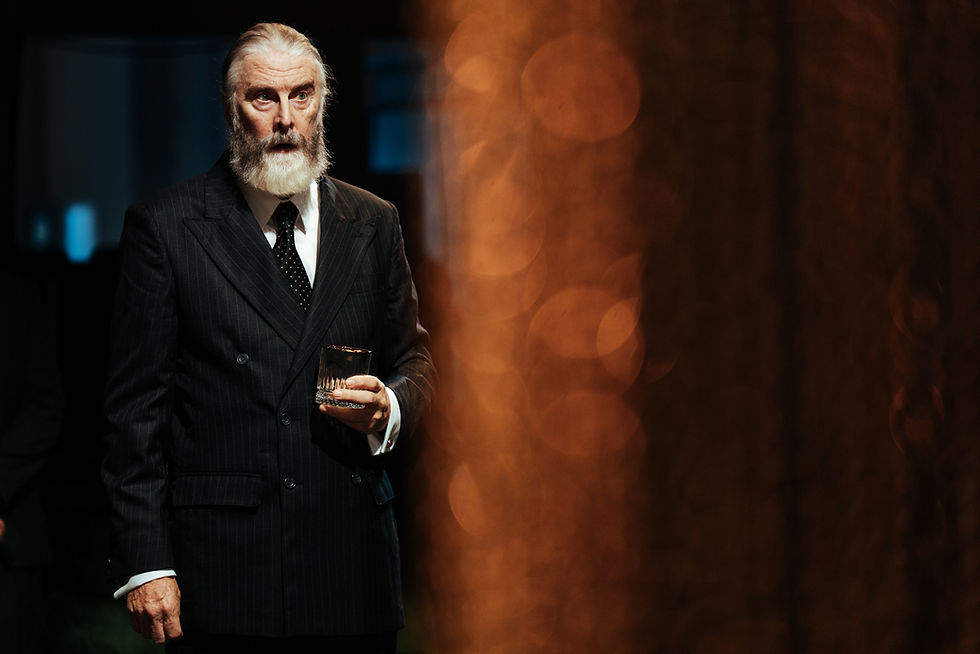
King Lear tells the story of an ageing British king who decides to divide his kingdom between his three daughters, Goneril, Regan and Cordelia. Before doing so, however, he asks each of them to publicly declare how much she loves him, with their answers determining what they will receive.
His two eldest daughters, Goneril and Regan, are quick to tell their father exactly what he wants to hear, showering him with exaggerated declarations of love. His youngest daughter, Cordelia, refuses to flatter him, believing that her love shouldn't need to be expressed through grand speeches. Angered by her response, Lear disowns Cordelia and divides his kingdom between her sisters instead.
Having surrendered his power, Lear soon discovers that his daughters are not quite as devoted as they initially appeared. As Goneril and Regan begin to turn against him, he finds himself increasingly isolated, struggling to accept that he no longer has the authority he once enjoyed.
Alongside Lear's story, we follow the Earl of Gloucester and his two sons, Edgar and Edmund. Resentful of his position within the family, Edmund sets out to manipulate his father and turn him against Edgar, creating another complicated family conflict with equally devastating consequences.
As the two storylines develop, the characters become caught up in a series of betrayals, shifting loyalties and struggles for power, with tragic consequences.
Matthew Dunster's adaptation places the story in a contemporary setting, opening with a lively party where the characters dance, drink and enjoy karaoke. It's certainly not the traditional Shakespearean opening you might expect, but it immediately establishes the characters as members of a wealthy, privileged family.
I enjoy modern interpretations of Shakespeare, particularly when the language has been updated to match the contemporary setting. However, I personally find it more difficult when a production uses modern costumes and surroundings while retaining Shakespeare's original language. I prefer the setting and language to feel consistent, so this combination took me a little while to adjust to.
It had also been several years since I'd last seen a Shakespeare play, and I initially found myself concentrating on the language while trying to work out who all the characters were and how they were connected. As a result, the first act felt quite lengthy, although there were some unexpected moments of humour along the way.
However, the second act was a completely different experience. By this point, I'd become much more comfortable with the language and familiar with the characters, while the pace of the story increased considerably. With betrayals, violence and deaths unfolding in quick succession, there was much more happening, and I found myself completely gripped.
The second act also contains some genuinely shocking moments, with the violence becoming increasingly brutal as the story progresses. Gloucester's blinding is particularly difficult to watch, with the way it is staged catching me completely off guard. It was certainly one of the most memorable moments of the evening and definitely not for the squeamish!
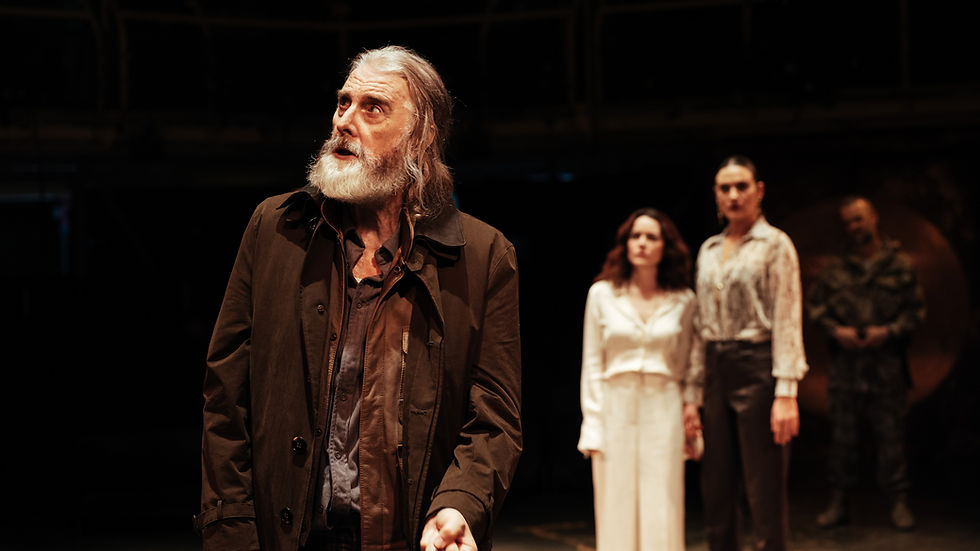
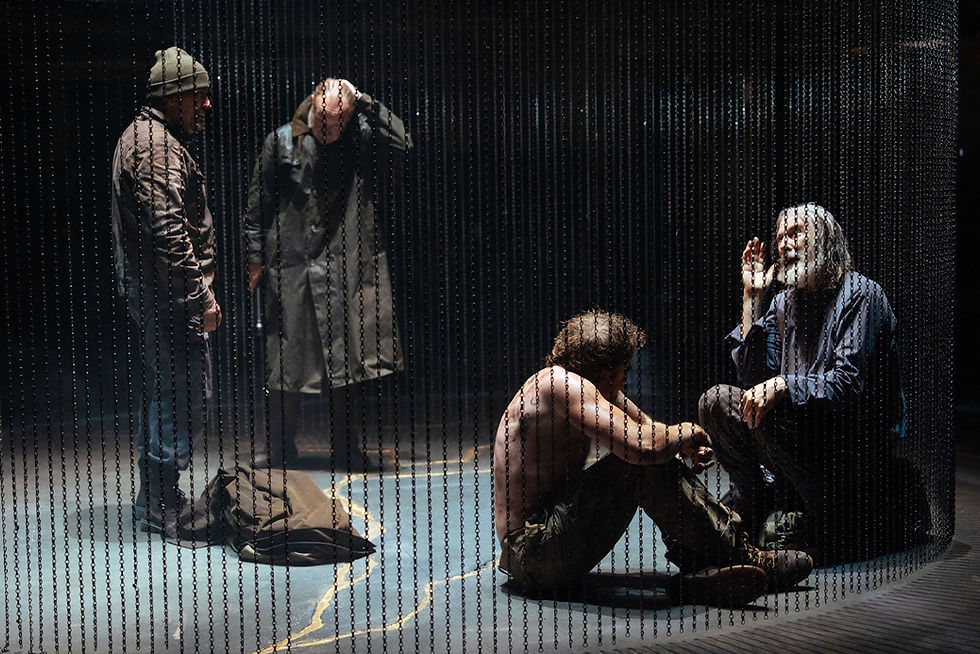
Anna Fleischle's set design was one of the first things that caught my attention when I entered the Royal Exchange Theatre. The dark stage floor was covered in large gold cracks, while enormous curtains made from hanging metal chains were suspended above it. I thought the cracks were a clever way of representing the divisions within Lear's family and kingdom, and I was intrigued to see how the hanging chains would be used during the performance.
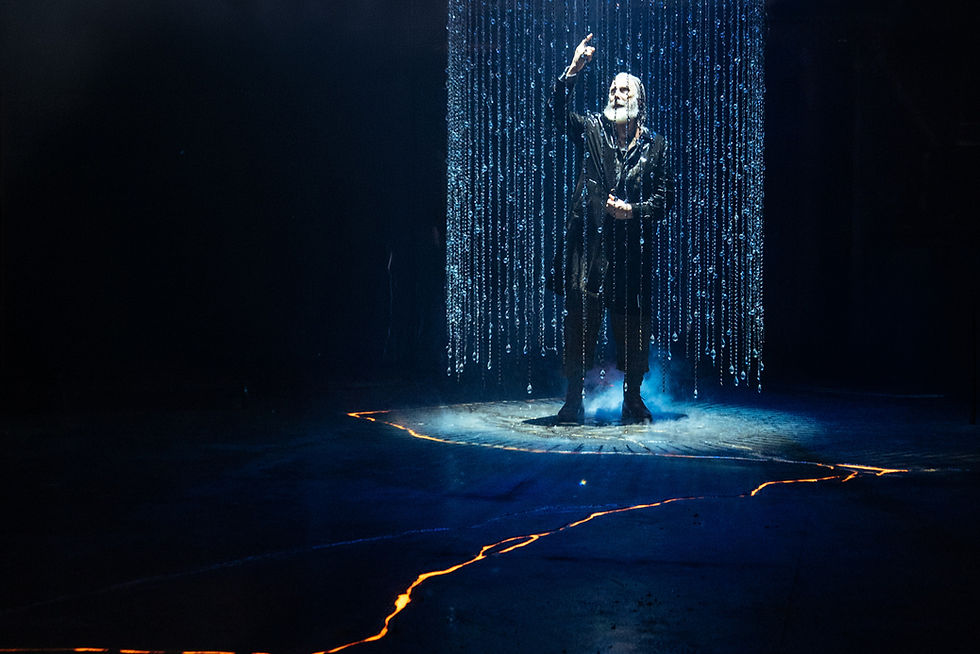
Although the stage initially appears quite bare, the design proves surprisingly versatile. The metal chains move up and down throughout the production, changing the appearance of the stage and helping to establish different locations. I particularly liked how something so simple could be used in so many ways, especially within the Royal Exchange's in-the-round setting.
Lucy Carter's lighting complements the set beautifully, making the chains an even more prominent feature of the production. The changing lighting also helps establish the mood of each scene, with the atmosphere becoming increasingly dark and dramatic as the story unfolds.
One of the production's most impressive sequences is the storm, which sees Lear exposed to the elements as his circumstances become increasingly desperate. With real water falling onto the stage, dramatic lighting and powerful thunder effects, the scene is incredibly atmospheric. Holly Khan's sound design works particularly well here, creating a convincing storm that adds to the intensity of Threlfall's performance. It was certainly one of the technical highlights of the evening.
Cat Fuller's costume design is another important part of the production's contemporary setting. The characters wear a mixture of smart suits, fashionable dresses and more casual clothing, with some particularly striking outfits worn by Lear's daughters. I thought the costumes worked well in establishing the characters' wealth and status, while also giving each of them a distinctive appearance.
Lear's changing appearance is particularly effective. At the beginning, he looks every inch the wealthy, powerful patriarch in his tailored suit, but as the story progresses, his smart clothing gives way to a much more dishevelled appearance. By the time we see him with his long hair loose and a makeshift crown of foliage, he looks almost unrecognisable from the commanding figure we met at the beginning.
Charlotte Broom's movement direction helps bring energy to the production, particularly during the opening party, where the characters dance and celebrate to familiar pop songs. As the story develops, the movement becomes increasingly physical, particularly during the confrontations and violent scenes. These moments are effectively staged, making the sudden changes from humour to brutality even more striking.
Music also plays an important part in establishing the atmosphere. The familiar songs and karaoke of the opening celebrations create a lively, contemporary setting, while Nadine Shah's original compositions provide a much darker accompaniment as the story unfolds. Together with Holly Khan's sound design, the music helps build tension and adds to the increasingly unsettling atmosphere.
Overall, the technical elements work extremely well together, creating a production that is visually impressive without relying on elaborate scenery. The combination of the hanging chains, lighting and sound is particularly effective and makes excellent use of the Royal Exchange's unique performance space.
David Threlfall delivers an outstanding performance as King Lear, bringing a commanding presence to the role from the beginning. Initially proud, demanding and accustomed to getting his own way, his Lear gradually becomes a very different character as he loses control of his kingdom and the people around him.
Threlfall handles this transformation brilliantly, portraying Lear's growing confusion and vulnerability as his circumstances become increasingly desperate. Despite his stubbornness and the mistakes he makes, there are moments when you can't help feeling sorry for him. It's a powerful and convincing performance, and although the entire cast were excellent, Threlfall was undoubtedly my standout performer of the evening.
Jonathan Slinger is also excellent as the Earl of Gloucester, whose complicated relationship with his two sons provides another important part of the story. He gives a convincing and increasingly emotional performance as Gloucester begins to suffer the consequences of his decisions. His scenes with Tom Varey's Edgar are particularly moving, while his performance during the shocking blinding scene is incredibly powerful.
Playing Gloucester's sons, Tom Varey and Paddy Stafford both deliver excellent performances as Edgar and Edmund. Stafford is particularly entertaining as the scheming Edmund, bringing plenty of confidence and unexpected humour to the role. Varey, meanwhile, impresses with his energetic and physical portrayal of Edgar, particularly during his transformation into Poor Tom. Their contrasting performances make Gloucester's family storyline just as engaging as Lear's.
As Lear's three daughters, Nadine Shah, Lisa Diveney and Isobel Akuwudike all deliver excellent performances, creating characters with very different personalities. Shah brings a commanding and calculating presence to Goneril, while Diveney gives Regan a more playful but increasingly ruthless personality. The two actresses work particularly well together, with their characters' initial alliance gradually giving way to rivalry as their ambitions grow.
Akuwudike provides an effective contrast as Cordelia, bringing a quieter and more sympathetic presence to the role. Although she has less stage time than her sisters, she makes an impression, particularly as her relationship with Lear becomes increasingly important towards the end of the play.
Jason Done is equally impressive as Kent, whose loyalty to Lear remains unwavering, even when he is treated unfairly. He brings sincerity and determination to the role, particularly in the moments when Kent is willing to challenge the king despite knowing the consequences. His performance provides a welcome contrast to the dishonesty and manipulation surrounding Lear.
With such a strong ensemble, the relationships between the characters become increasingly convincing as the story progresses. Even with two families and several different storylines to follow, the cast work together extremely well, ensuring that each character has an important part to play in the unfolding tragedy.
King Lear at the Royal Exchange Theatre is a bold and atmospheric production that combines outstanding performances with imaginative staging and impressive technical design.
David Threlfall is exceptional in the title role, delivering a powerful portrayal of Lear's gradual decline from a proud and demanding king to a vulnerable man struggling with the consequences of his decisions. Although he was my standout performer, the entire cast were excellent, with Jonathan Slinger, Tom Varey and Paddy Stafford among the particular highlights.
The production design is equally impressive, especially the enormous hanging chains, dramatic lighting and incredibly effective storm sequence. These elements create some memorable moments and demonstrate just how well the Royal Exchange's in-the-round space can be used.
Although I enjoy modern interpretations of Shakespeare, the combination of contemporary staging and traditional language took me a little while to adjust to. The first act felt quite lengthy as I familiarised myself with the characters and dialogue, but the second act was a completely different experience. With the pace increasing and some genuinely shocking moments, I found myself completely gripped.
At just over three hours, this is certainly a substantial evening at the theatre, but the strength of the performances and the increasingly dramatic story make it a rewarding experience. As someone who wasn't particularly familiar with King Lear beforehand, I came away with a much greater appreciation of the play.
With outstanding performances, striking staging and moments that are both moving and genuinely shocking, King Lear is a powerful production that certainly leaves a lasting impression.
A powerful and visually spectacular production, brought to life by an outstanding cast.
King Lear is booking at the Royal Exchange Theatre, Manchester until Saturday 15 November 2026. Tickets are available via the link below.
Photo Credit - Helen Murray
*Our tickets for this show were kindly gifted in exchange for an honest review.


Comments