
REVIEW - TO KILL A MOCKINGBIRD | THE LOWRY | 14/01/2026

Updated: Feb 5


To Kill A Mockingbird at The Lowry Theatre – A Story That Still Demands to Be Heard
First published in 1960, To Kill a Mockingbird has become one of the most widely studied and discussed novels of the modern era. Its themes of racial injustice, morality and empathy have ensured its place in classrooms and cultural conversations for over sixty years.
This stage adaptation, written by Aaron Sorkin and directed by Bartlett Sher, brings the story to the stage with a sharp focus on language, character and moral conflict.
Going into To Kill A Mockingbird at The Lowry Theatre, I had never read the book or seen the film, so I experienced the story entirely fresh. Without nostalgia or preconceived attachment, the production stood on its own, allowing the performances and storytelling to unfold with clarity and impact.

Set in 1930s Maycomb, Alabama, the story is framed through the memories of Scout, her brother Jem, and their friend Dill. They recall a defining period in their childhood, centred around the trial of Tom Robinson, a Black man falsely accused of raping a young white woman.
Their father, Atticus Finch, takes on Robinson’s defence despite intense hostility from the community, fully aware of the personal and professional risks involved. The narrative moves fluidly between courtroom scenes and moments of childhood innocence, balancing humour, curiosity and warmth against a growing sense of injustice.
Even for someone encountering the story for the first time, the weight of inevitability is clear. What makes the production so effective is not the outcome of the trial, but the journey towards it — and the uncomfortable recognition of how familiar the arguments, language and prejudice still feel today.

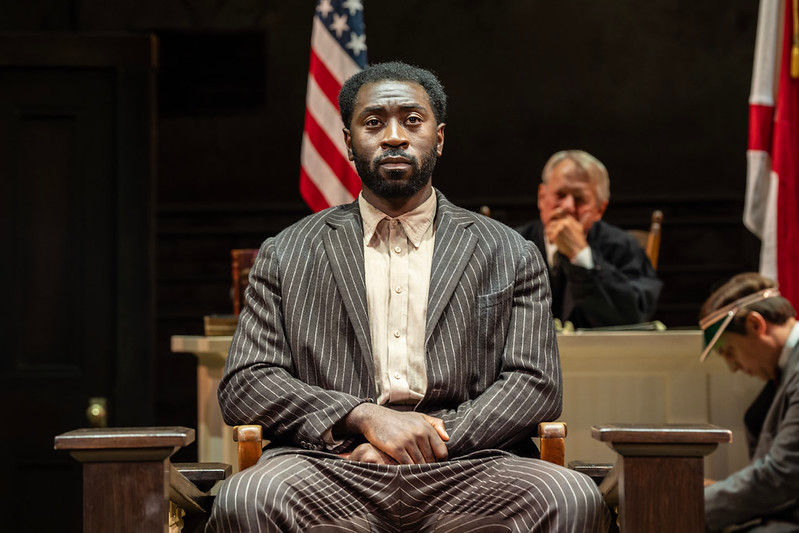
Miriam Buether’s set design allows the story to move seamlessly between locations, with large rolling pieces transforming the stage from the Finch family porch to jail cells and finally to a courtroom that dominates the space. The design supports the storytelling without ever interrupting its momentum.
Costumes firmly place the production in its period, with subtle details that quietly establish class, age and character. Scout’s clothing captures the physicality of childhood convincingly, while Atticus’s understated suits reflect his quiet authority and moral restraint.
Lighting is deliberately restrained, guiding focus and atmosphere without drawing attention to itself, while the sound design remains minimal. This choice keeps the emphasis firmly on the dialogue, allowing Aaron Sorkin’s script to take centre stage.
The performances across the company are outstanding. At the performance I attended, several understudies were on, including John J. O’Hagan as Atticus Finch, James Mitchell as Link Deas, and Tom Brace-Jenkins as Mr Ruscoe and Dr Reynolds. Each stepped into their roles seamlessly, maintaining the production’s emotional and dramatic integrity.
John J. O’Hagan’s Atticus is impressively controlled, with a sense of inner conflict always present beneath the surface. His performance is measured and thoughtful, allowing the character’s moral weight to build naturally rather than relying on grand gestures.
Andrea Davy brings intelligence and authority to Calpurnia, her presence growing in strength as the story unfolds. Her scenes with Atticus are particularly compelling, charged with tension and mutual respect, and she gives powerful voice to a community too often expected to remain silent.
Scout, Jem and Dill are portrayed with remarkable physicality and emotional truth, capturing the openness, awkwardness and vulnerability of childhood. Anna Munden’s Scout leads the narrative with warmth and honesty, while Dylan Malyn’s Dill brings a sense of longing and emotional depth that lingers long after the final scenes.
Tom Robinson is portrayed with quiet dignity, his restraint and vulnerability making the injustice he faces all the more devastating. It is a performance that grounds the courtroom drama in human consequence

To Kill A Mockingbird at The Lowry Theatre is a powerful, intelligent and deeply affecting piece of theatre. Experiencing this story for the first time through Aaron Sorkin’s stage adaptation was both confronting and illuminating, allowing its themes to land with striking clarity.
This production does not offer comfort or easy answers. Instead, it asks the audience to listen, reflect and consider where they stand in the face of injustice. With exceptional performances, thoughtful direction and a script that feels painfully relevant, this is theatre at its most vital.
A gripping and essential production that proves some stories must continue to be told.
To Kill a Mockingbird will be at The Lowry until Saturday, 24th January 2026. Tickets are available for purchase through the link provided below.
For more information about the show, please click the button below to visit the official website.
Photo Credit - Johan Persson
*Our tickets for this show were kindly gifted in exchange for an honest review.


Comments